

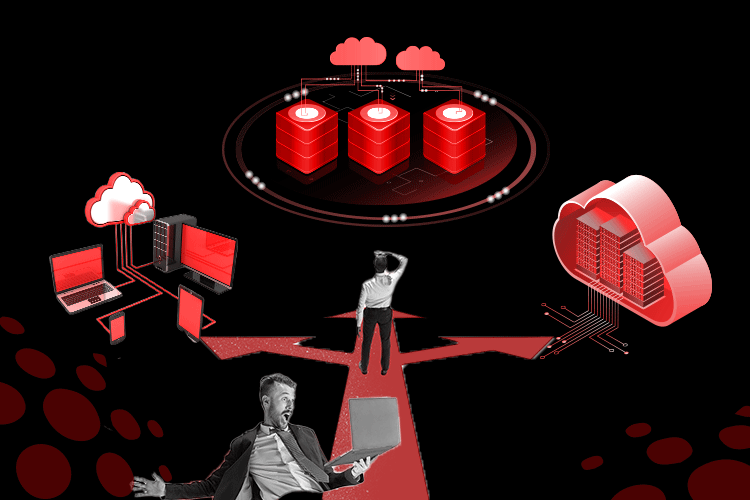


Multi-cloud specifies the power to support the organization’s multiple requirements. Now, to precisely understand what multi-cloud strategy is. It is where an organization leverages two or more cloud computing platforms to perform various tasks. Organizations that do not want to depend on a single cloud vendor may use resources from several providers to get the best benefits from each unique service.
A multi-cloud platform may refer to the combination of software as a service (SaaS), platform as a service (PaaS), and infrastructure as a service (IaaS) model. It may also refer to the use of several private clouds and public cloud solutions. The power of the cloud also changes the way we work by automating processes and enabling real-time collaboration between people globally.
Multi-cloud strategies are implemented for a variety of reasons. Some organizations want to avoid dependency on a single cloud provider, reducing financial risk. Also, some organizations decide upon a multi-cloud strategy to mitigate the risk of localized hardware failure. Multi-cloud drastically minimizes the risk of catastrophic failure. The need for multi-cloud hosting doesn’t stop here. It has numerous advantages to support your project for future scopes. Changes in specific modules require separate development and testing needs with an everyday increase in app users. These kinds of requirements can be handled in a very short time.
Customers from different countries may have specific demands for features. These demands can only be served with a blend of multiple cloud platforms or an altogether different cloud vendor that needs to be added to the strategy. Ultimately, you not only get the benefits of improved user experience with multiple data centres but also fulfill development needs by consuming services from multiple proprietary cloud solutions.
Now, let’s talk about why enterprises need it. It is because they can adopt a multi-cloud strategy to acquire an optimal distribution of assets across the user’s cloud hosting environments. With a multi-cloud strategy, businesses can access multiple options such as favorable service level agreement terms and conditions, greater upload speed selection, customizable capacity, cost terms, and many more.
The most important reasons why enterprises choose a multi-cloud approach are as mentioned below:
- Flexibility: The merging of multiple cloud platforms, whether public or private and even on-premise resources allows organizations to establish uniform standards, which immediately help raise the quality of their process and reduce administration time.
- Market Opportunities: Cloud platforms and services offer a vast range of capabilities. They can have benefits from cloud elasticity and speed, making them more responsive to industry demands.
- Improve ROI: Each cloud has its collection of services, functions, rules, and price models. Rapid shifts in the dynamic business scene make it challenging to identify the most excellent organization’s needs—agility, dependability, and TCO increase ROI when applications get distributed against multiple clouds.
- Centralisation: One of the most important reasons for adopting a multi-cloud strategy is to improve data management efficiency across all the resources that operate across multiple platforms. It may also detail data management, from which organizations can govern the services of several cloud platforms.
- Enhanced Security: Businesses that are hesitant to use cloud computing are most concerned about losing control over critical data and software. An on-site private environment is one solution to provide firms with granular control, transparency, and comprehensive visibility into their IT resources.
- Prevention of Vendor Lock-In: With a multi-cloud strategy, enterprises can evaluate the benefit terms and pitfalls of multiple service providers and switch to another vendor after negotiation and careful validation.
Most Enterprises have now switched to cloud computing for the reasons mentioned above. With this advanced technology, life has become much easier for fast-moving entrepreneurs. Among many enterprises supporting cloud strategies, we have one of the most relevant cloud consulting companies, “Convelox”, who are the leaders with a vision of delivering quality in cloud consulting. They offer services like:
- Oracle Cloud ERP
- Oracle cloud HCM
- Oracle Cloud CX
- Oracle Cloud HCM
Along with this, they have been advancing in many industries like communications, retail, insurance, entertainment, financial services, import and export and many more.
To conclude, the multi-cloud strategy has proved to be a very innovative technique that enterprises can use for future enhancements.